
1

Leon
5
Casino plus sportsQuick withdrawalsRound-the-clock chat
150% up to $1,500
+ 100 Free Spins
SmartSoft's Chicken Ways puts a chicken in the bottom corner of a 13×13 board and the 10,000x tile in the opposite one. Every jump goes right, up or diagonally, and the diagonal always pays the most. Bank from 1.05x. 97.00% RTP, high volatility.
Forget the single-lane road most chicken games use. Chicken Ways is played on a square board of 169 tiles, 13 across and 13 up, and every tile has its multiplier printed on it before you bet. The chicken starts on the 1x tile in the bottom-left corner. The 10,000x tile sits in the top-right one, and between them is a field of values that only ever grow as you move right or up.
From wherever the chicken stands you get up to three jumps: one tile right, one tile up, or one tile diagonally. The two straight jumps creep forward in small steps (from the start that's 1.05x or 1.1x). The diagonal is the hard option, and it always lands on the biggest number of the three: 1.5x on the opening move, 3x when you're sitting on 2x. Each jump either clears or hits a trap. A trap ends the round and takes the stake.
What you win is the number on the tile you're standing on when you press Cash Out, so the route itself doesn't pay a bonus. Twelve diagonal jumps in a row is the shortest way to 10,000x. Hug the edges and it takes 24. SmartSoft rates the game at 97.00% RTP and high volatility, and the board was identical in every demo session we loaded.
SmartSoft's published return.
The top-right tile.
Smallest collect allowed.
Fewest jumps to 10,000x.
Numbers from rounds we played in SmartSoft's own demo. Look down the diagonal column: it's always the biggest number on the row, and the gap keeps widening as you climb.
| Standing on | Right | Up | Diagonal |
|---|---|---|---|
| 1x (start) | 1.05x | 1.1x | 1.5x |
| 2x | 2.2x | 2.1x | 3x |
| 6x | 7x | 10x | 12x |
| 10x | 12x | 15x | 20x |
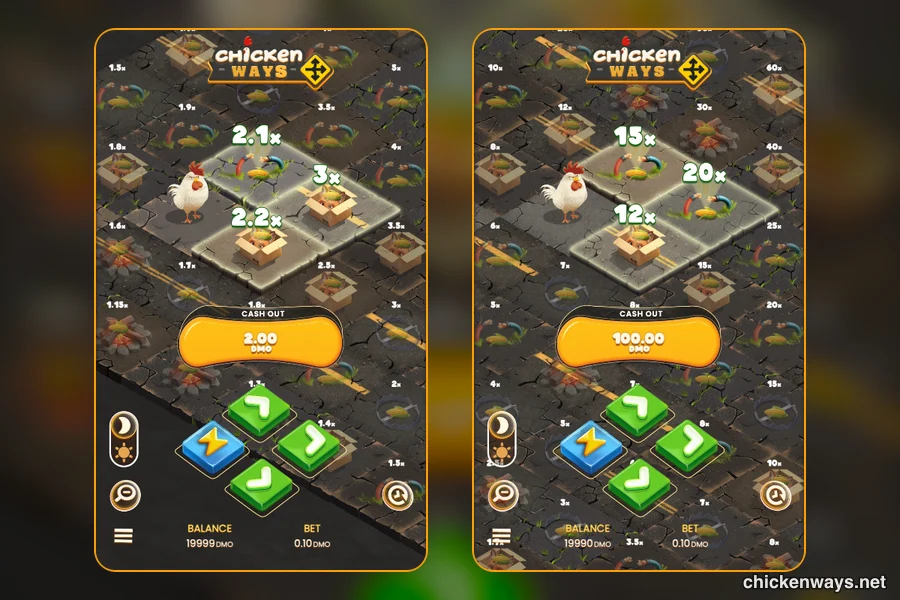
So which way should you go? That depends on what you're trying to protect. Sitting on 2x, the straight jumps add a tenth or two. The diagonal adds a whole 1x. Sitting on 10x, the diagonal doubles you. SmartSoft doesn't say how likely each jump is to clear, so the honest answer is this: a bigger number on the next tile means a bigger chance of losing the tile you're on. Full rules are in the Chicken Ways rules guide.
Licensed casinos that carry SmartSoft's catalogue. Check the bet range and payout cap in the game's info screen before your first jump.





18+ only | Set a limit first | BeGambleAware.org
SmartSoft publishes one return figure, 97.00%, and no trap odds per jump. Here's a useful shortcut, as long as you remember it's arithmetic and not a published table. If 97% holds wherever you cash out, the chance of getting to a tile is roughly 0.97 divided by its multiplier. That puts a 2x tile near a coin flip (48.5%), a 10x tile near one round in ten, and the 10,000x corner near one round in 10,300.
Two things follow. First, the route doesn't change the price of a tile. It only changes how many separate jumps you split the risk into. Second, a target set before the bet is worth more than any feel for the board, because the board can't tell you where the next trap is. The RTP and odds page runs the numbers for every common target.
Most games in this niche fix your difficulty once and then just ask when to stop. Chicken Ways asks two questions on every tile: which way, and whether to go at all. Here's how it sits against the step and crash games we cover elsewhere:
There's no bonus round and no feature buy. These are the parts that do the work, each covered in detail on the Chicken Ways features page.
Answers checked against SmartSoft's rules and demo.